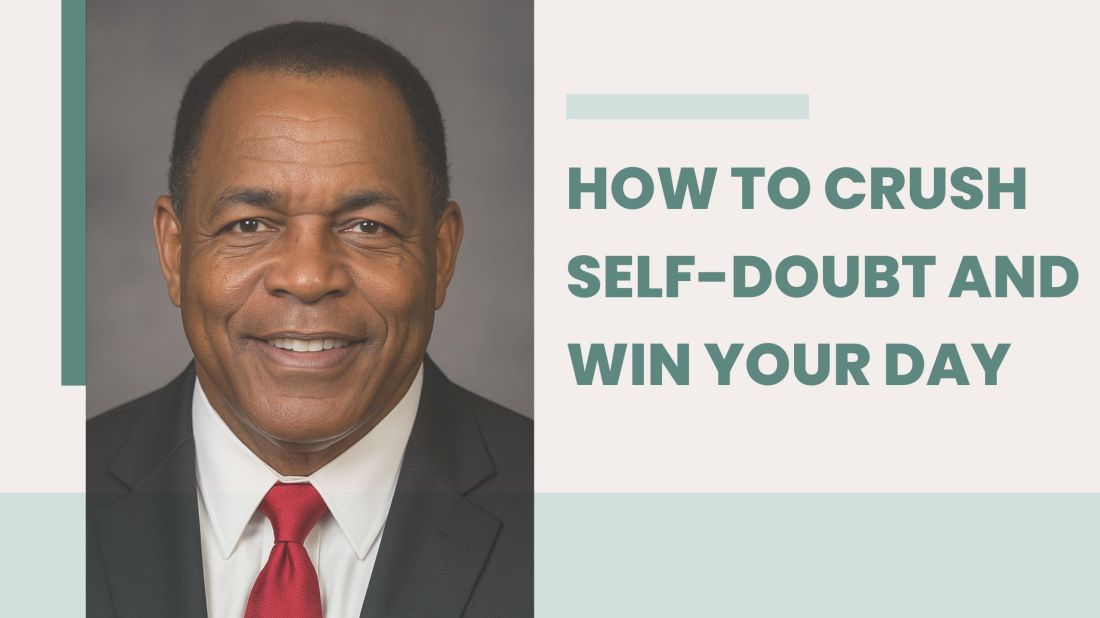
How to Crush Self-Doubt and Win Your Day

Desmond Gumbs

Every single person, from the biggest sports star to the everyday professional, deals with self-doubt. That little voice in your head that whispers, “You can’t do this,” or “You are not ready,” is the biggest opponent every athlete faces. And just like on the field, winning against self-doubt requires training, strategy, and a strong inner guide.

This is the central lesson taught by Desmond Gumbs, the renowned leader who is much more than a sports coach. He is a high-impact life coach and an electrifying motivational speaker who specializes in helping people build a champion’s mindset. He believes that the same tools that help an athlete win a championship game can help you achieve your goals in life, work, or school.

Here are five simple, powerful strategies from Desmond Gumbs’ playbook that you can use right now to silence self-doubt and unlock your true potential.

1. The Five-Minute Rule: Beat Procrastination with a Sprint

Self-doubt often starts as procrastination (the act of intentionally delaying a task or goal). We often look at a huge task—a major project or a tough workout—and our mind magnifies the effort until it feels impossible, causing us to freeze. Coach Gumbs teaches that in any competitive environment, decisive action defeats stagnation. 

His simple solution is the “Five-Minute Rule”: instead of committing to the entire task, you simply commit to five minutes of focused, distraction-free effort. You give yourself permission to stop after that brief period, which bypasses the brain’s resistance to starting. 

Gumbs knows that once you take this first step, momentum takes over. This small act of discipline is a guaranteed way to defeat the mental block, changing a passive, fearful plan into a source of immediate internal motivation.

2. Visualize the Victory: Win in Your Mind First

The mind is the ultimate training ground, and elite athletes don’t just practice physically; they mentally rehearse their success, a powerful technique championed by Coach Gumbs. He reminds his clients that you have to “win in your mind a thousand times” before you ever face the real challenge. 

To apply this practice, take 60 seconds each day to vividly imagine yourself successfully completing the difficult task. See yourself delivering a flawless presentation, hitting your sales target, or responding to a tough conversation with composure. You must engage all your senses in this mental rehearsal. 

By creating this detailed mental blueprint of success, you are priming your nervous system to execute it. When the real moment arrives, your mind and body have already been there, which boosts your confidence and makes your winning mindset instinctive.

3. Reframe Failure: Adversity is Just Feedback

Self-doubt is intensely fueled by the fear of failure. When an obstacle appears, the natural reaction is to internalize the event and decide, “I am a failure.” Desmond Gumbs teaches that a setback is not a sign you are on the wrong path; it is merely data showing your current method didn’t work. The difference between a champion and a quitter is the speed of the rebound. To handle adversity effectively, adopt the simple “A.A.R. Framework” from the sports coach playbook. 

First, “Acknowledge” the disappointment and allow yourself a brief moment to feel the emotion without letting it take control. Second, “Analyze” what happened by shifting into a purely objective mode to identify the one crucial lesson you can take from the event. Third, “Respond” by using that lesson to formulate a new plan of action, immediately shifting your focus from the past event to the future. 

This proactive step is the core of mental toughness, turning an apparent loss into a valuable lesson and demonstrating the discipline required for achieving lasting success.

4. Stack the Wins: Building Unshakeable Confidence

Many people mistakenly believe confidence is a fixed trait, but Coach Gumbs clarifies that confidence is earned. It is the quiet, deep-seated knowledge that you have prepared. If you wait until the big game or the big interview to feel confident, you have already lost. 

To build an unshakeable inner belief, you must intentionally “stack the wins” every single day. These are not huge victories; they are the small, non-negotiable promises you keep to yourself. They could be completing a tough drill, finishing a challenging task with focus, or even adhering to a small new habit. 

Each small win acts as a deposit into your self-belief bank. When self-doubt creeps in during a high-pressure situation, you can draw on this reserve of proven effort, establishing a habit of reliable, consistent execution that is the true foundation of an athlete’s winning mindset.

5. Know Your “Why”: Purpose is Stronger than Pain

If your motivation relies purely on temporary excitement or external reward, it will inevitably fade the moment the work gets difficult. This lack of resilience is why many people quit halfway through a major goal. 

Desmond Gumbs always challenges his audience to define their “why,” to ensure it is an emotional anchor that is stronger than the temporary pain of the work itself. Your task is to write out why your big goal truly matters, connecting it deeply to your core values (e.g., family security, personal legacy, serving your community). 

When the training is hard or rejection is stinging, this profound “why” pulls you forward. It transforms the work from something you have to do into something you get to do, fueling your deepest internal motivation. 

Wrap Up

The principles of high-performance are universal, applying whether you are coached by a great sports coach to run a marathon or guided by a great life coach to change your career.

Desmond Gumbs offers an integrated, powerful system to transform your performance—not just in one area, but across your entire life. If you’re tired of that inner voice of doubt holding you back, it’s time to invest in your mental toughness and learn the champion’s secret to unstoppable forward momentum. Are you ready to stop waiting and start winning? Connect with Desmond Gumbs today to find out how his coaching and speaking services can unlock the full force of your winning mindset. Your game-changing moment is waiting.
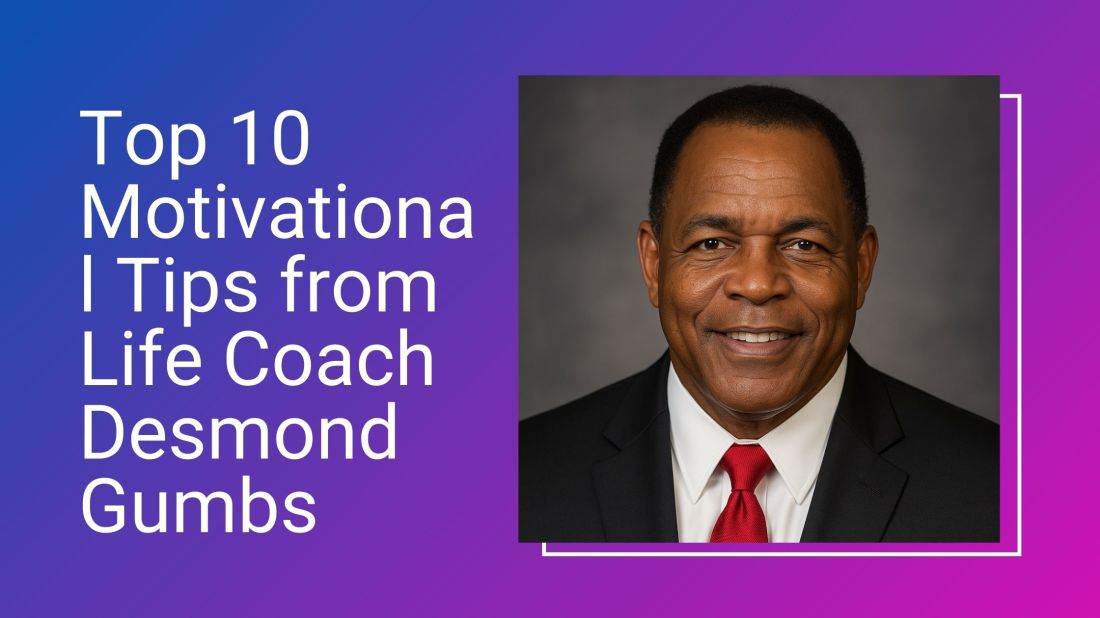
Top 10 Motivational Tips from Life Coach Desmond Gumbs

Desmond Gumbs

Motivation. It’s the spark that ignites action, the fuel that drives us toward our goals. Yet, for many, it can feel like a flickering flame, bright one moment, nearly extinguished the next. For renowned life coach and motivational speaker Desmond Gumbs, motivation isn’t a magical gift but a skill that can be built, sustained, and made an unshakable part of daily life.

Through years of helping thousands, from elite athletes to corporate leaders, Desmond Gumbs has developed a robust framework for achieving excellence. His journey as a Sports Coach and mentor has revealed that the principles of high achievement are universal. These aren’t just feel-good platitudes; they are battle-tested strategies that have proven effective. For anyone looking to unlock their potential and build unstoppable momentum, here are the top 10 motivational tips from Desmond Gumbs‘ playbook.

1. Define Your “Why” with Unshakable Clarity

A core principle in Gumbs’ coaching is that before you can figure out how to achieve something, you must know why you want it. This “why” is the ultimate purpose, the emotional anchor that holds you steady when challenges arise. It could be providing a better life for your family, achieving personal freedom, or making a tangible impact on a community.

In his work designing and leading an Athletic Program, Gumbs establishes the collective “why” before ever discussing a training regimen. The team understands the deep reason they endure gruelling practices: to represent their school with pride, push their limits, and achieve something great together.

Action Step: Gumbs advises taking 30 minutes, free of distractions, to write down what you truly want to achieve. Then, ask “why” five times, digging deeper with each answer to find the emotional core that will fuel your journey.

2. Break Down Your Everest into Climbable Hills

A massive goal can be paralyzing. Desmond Gumbs teaches that the secret to conquering a mountain-sized goal is to break it down into small, manageable, and actionable steps. Instead of a vague goal like “start a successful business,” he would advise a concrete first step: “This week, I will research my target market for three hours and draft a one-page business plan.”

A Sports Coach like Gumbs doesn’t tell a player to “become the best.” They focus on specifics: “Let’s improve your free-throw percentage by 2% this month.” By focusing on small, incremental progress, individuals build momentum and confidence. Each small win serves as a dose of motivation for the next step.

3. Celebrate Every Single Small Victory

In the pursuit of big goals, it’s common to overlook the progress made along the way. Gumbs considers this a huge mistake. He emphasizes that celebrating small wins is crucial for maintaining long-term motivation. Completing a task or reaching a mini-milestone triggers the release of dopamine in the brain, creating a positive feedback loop: you do something good, you feel good, and you become more motivated for the next challenge. The lesson is not to wait until the finish line to feel proud, but to celebrate finishing the first mile.

4. Visualize Success with Intense Detail

Top athletes have long used visualization, a technique central to Gumbs’ coaching. He teaches that this is more than just daydreaming; it’s the practice of creating a vivid mental image of you achieving your goals by engaging all the senses. What does it feel like to get that promotion? What does it sound like when the crowd cheers? What do you see when you achieve your financial goal?

As Desmond Gumbs guides his clients, he turns this into a daily practice. By repeatedly visualizing success, a person can train their brain to believe the outcome is possible, building the neural pathways that help recognize opportunities and maintain focus.

5. Reframe Failure as Essential Feedback

Fear of failure is one of the biggest motivators. Gumbs’ philosophy is centered on changing one’s relationship with failure. He teaches that failure is not a reflection of a person’s worth; it is simply data and feedback on what didn’t work.

Every great athlete has lost games, and every successful entrepreneur has had failed ideas. What sets them apart is their ability to extract the lesson, adjust their strategy, and get back in the game. When something doesn’t go as planned, Gumbs advises against saying “I failed,” but instead asking, “What did I learn?”

6. Curate a Supportive Environment

A well-known adage is that you are the average of the five people you spend the most time with. Gumbs believes deeply in this, teaching that one’s environment, including friends, family, and colleagues, has a profound impact on motivation and mindset. Being surrounded by negativity and doubt makes it incredibly difficult to stay positive and driven.

His advice is to seek out people who inspire, challenge, and believe in your potential. Finding a mentor, joining a mastermind group, or simply being more intentional about who you give your time to creates a strong support system that acts like a tailwind, making the journey forward feel easier.

7. Prioritize Your Physical and Mental Well-being

“You can’t pour from an empty cup” is a phrase often heard in Gumbs’ coaching sessions. Pushing oneself to the point of burnout is not a sustainable approach to achieving success. Motivation is closely tied to both physical and mental health. This means prioritizing sleep, a balanced diet, regular exercise, and time for mental relaxation.

In his work with athletes, the recovery plan is just as important as the training plan. The same applies to life. Gumbs stresses that people are far more motivated, creative, and resilient when operating from a place of strength and wellness.

8. Master the Art of Daily Discipline

Desmond Gumbs makes a clear distinction: Motivation gets you started, but discipline keeps you going. He teaches that motivation is an emotion that ebbs and flows, and therefore cannot be relied upon daily.

Discipline, on the other hand, is about establishing habits and routines that are consistently followed, regardless of one’s emotions or mood. It’s about showing up even on the days you don’t want to. A disciplined person can achieve incredible things because they are not at the mercy of their fleeting moods. His method is to start by building one small, positive habit and sticking to it for 30 days to develop the discipline muscle.

9. Intentionally Step Outside Your Comfort Zone

The comfort zone is a place of safety, but, as Gumbs notes, nothing ever grows there. Proper growth and breakthrough moments happen when you challenge yourself and step into the unknown. Consistently pushing boundaries builds self-confidence and resilience.

He suggests starting small: take a different route to work, try a new workout, or speak up in a meeting. Each time a person does something slightly scary, they expand the edges of their comfort zone and prove to themselves that they are more capable than they thought they were.

10. Find a Coach or Mentor

Even the best athletes in the world have coaches. Gumbs highlights this to make a crucial point: a coach can see your blind spots. They offer a fresh perspective, provide accountability, and equip you with strategies to excel. A great mentor or coach can accelerate progress tenfold.

As a life coach and motivational speaker, Desmond Gumbs’ greatest joy comes from helping people see the greatness within themselves. He firmly believes that investing in guidance from someone who has been where you want to go is one of the most powerful moves for personal and professional growth.

Your Journey Starts Now

Motivation isn’t a destination; it’s a daily practice. By integrating Desmond Gumbs’ strategies into your life, you can build a robust and sustainable engine for success. Pick one or two of these tips that resonate and start implementing them today. The path to achieving great dreams is built one disciplined, motivated step at a time.

Simple Steps from Desmond Gumbs to Build Your Confidence Today

motivational speaker

Imagine sitting down with Desmond Gumbs, a life coach and motivational speaker whose energy and wisdom light up any room. With a career rooted in his roles as an athletic director and sports coach, Desmond has guided thousands toward personal and professional breakthroughs. His approach is refreshingly straightforward: blend discipline, clear goals, and heartfelt encouragement to unlock your potential. In this conversational journey, Desmond shares simple, actionable steps to build confidence, drawing from his deep experience in coaching athletes and mentoring individuals. Let’s dive into his insights, delivered with the warmth and authority that make him a trusted voice in personal development.

Desmond Gumbs: A Guide to Transformation

Desmond Gumbs isn’t just a coach—he’s a catalyst for change. His journey began on the sports field, where, as a sports coach, he saw how discipline and teamwork could transform lives. “I noticed that the same principles that helped athletes win games could help anyone succeed,” Desmond reflects. His time as an athletic director sharpened his ability to inspire teams, but he wanted to reach beyond sports. That’s when he stepped into life coaching, driven by a passion to empower people to overcome barriers and chase their dreams.

What sets Desmond apart is his authenticity. He doesn’t just preach success; he shares real stories from his own life and those he’s mentored. Whether he’s speaking to a corporate team or posting insights on X (@coachgumbs1), his message is clear: you have the power to change your life, one step at a time. Let’s explore the practical steps Desmond offers to build confidence, straight from our conversation.

Step 1: Start with Clear Goals

Desmond leans forward, his voice steady but warm. “Confidence begins with knowing where you’re headed,” he says. As a life coach and motivational speaker, he’s seen how setting clear, achievable goals can shift someone’s mindset. “Think of an athlete training for a race. They don’t just aim to ‘run faster’—they target a specific time. That clarity fuels their drive.”

To apply this, Desmond suggests picking one goal that excites you. Maybe it’s landing a new job, improving your public speaking, or even running a 5K. Break it into small, doable steps. “If you want to speak confidently, start by practicing one sentence in front of a mirror each day,” he advises. These small wins stack up, creating a sense of accomplishment that naturally boosts confidence. Desmond’s work with athletic programs shows how this focus on measurable progress turns dreams into reality.

Step 2: Embrace a Growth Mindset

Barriers—self-doubt, fear, or external challenges—can feel like brick walls. Desmond, with his sports coach perspective, sees them differently. “In sports, a missed shot isn’t failure; it’s feedback,” he explains. He encourages a growth mindset, where challenges become opportunities to learn. “When I coached athletes, I’d tell them, ‘Every setback teaches you something.’ The same applies to life.”

To put this into practice, Desmond recommends reflecting on a recent challenge. Grab a notebook and write down what happened and what you learned. Maybe you didn’t get that promotion—ask yourself, “What skills can I build to be ready next time?” This shift in thinking, Desmond says, rewires your brain to see obstacles as stepping stones. It’s a strategy he’s used with clients across his coaching career, helping them replace self-doubt with resilience.

Step 3: Take Consistent Action

“Confidence isn’t something you wait for—it’s something you build through action,” Desmond says with conviction. His experience running athletic programs taught him the power of consistency. “Athletes don’t become champions overnight. They show up every day, putting in the work. You can do the same.”

Desmond’s advice is practical: pick one small action tied to your goal and do it daily. Want to feel more confident at work? Spend 10 minutes each morning reviewing your priorities or practicing a skill, like writing or presenting. “Consistency turns effort into habit, and habit builds confidence,” he says. He recalls a client who wanted to improve her leadership presence. By practicing one assertive phrase daily, she went from hesitant to commanding meetings in months. Small steps, Desmond emphasizes, lead to big results.

Step 4: Build Your Support System

Desmond’s eyes light up when he talks about the power of community. “No one wins alone,” he says, drawing from his days as a sports coach. “On a team, players lift each other up. In life, you need the same—a group that believes in you.” Whether it’s a mentor, friend, or professional network, surrounding yourself with positive people fuels confidence.

To start, Desmond suggests reaching out to someone who inspires you. “It could be as simple as asking a colleague for feedback or joining a group aligned with your goals,” he says. He points to his own online community on platforms like Medium (@desmondgumbs) and SoundCloud, where he shares motivational content to create a virtual support network. “When you know others are rooting for you, it’s easier to take bold steps,” he adds.

Lessons from Sports for Everyday Life

Desmond’s background in sports shapes his approach to life coaching. “Sports teach you discipline, teamwork, and how to stay focused under pressure,” he says. These lessons translate seamlessly to personal growth. As an athletic director, he saw how structured training turned raw talent into excellence. He applies the same structure to his coaching clients, helping them build habits that last.

“Discipline isn’t about perfection,” Desmond explains. “It’s about showing up, even when you don’t feel like it.” He suggests creating a simple routine—like setting aside 15 minutes daily for your goal—and sticking to it. This mirrors the training schedules he designed for athletes, ensuring steady progress. Teamwork, too, plays a role. “Find ways to contribute to a group,” he says. “Whether it’s a work project or a community event, being part of something bigger boosts your sense of purpose.”

Connecting Through Digital Platforms

Desmond’s influence extends far beyond one-on-one coaching. Through his X profile (@coachgumbs1), he shares bite-sized tips that spark motivation. On Medium and Vocal Media, he dives deeper, writing about goal-setting and overcoming obstacles. His SoundCloud audios bring his voice directly to listeners, offering inspiration on the go. “I want to meet people where they are,” he says. “Whether they’re reading an article or listening during a commute, my goal is to make growth accessible.”

His Quora answers and F6S profile further showcase his expertise, providing practical advice and highlighting his achievements as a life coach and motivational speaker. Desmond’s online presence is a testament to his commitment to empowering a global audience with tools for success.

Tackling Confidence Killers

Desmond knows confidence can be fragile. Fear of failure and comparison often hold people back. “Fear is normal,” he says, “but it doesn’t have to stop you.” He suggests starting with low-stakes actions to build courage. “If you’re scared to speak up in meetings, try asking one question this week,” he advises. Each small step reduces fear’s grip.

Comparison, especially on social media, is another confidence killer. “Focus on your own race,” Desmond urges, a lesson from his sports coach days. Instead of measuring yourself against others, track your progress. “Keep a journal of your wins, no matter how small,” he says. “Seeing how far you’ve come builds unshakable confidence.”

Conclusion: Your Journey to Confidence

Desmond Gumbs, with his wealth of experience as a life coach and motivational speaker, offers a clear path to confidence: set goals, embrace growth, act consistently, and lean on your community. His insights, drawn from years as an athletic director and sports coach, make these steps relatable and actionable. “Your goals are within reach,” Desmond says with a smile. “Take one step today, and you’re already closer.”

Whether you’re aiming to lead with authority, improve your skills, or find clarity in your purpose, Desmond’s advice cuts through the noise. Start small, stay consistent, and surround yourself with support. Follow Desmond on X (@coachgumbs1) for daily doses of inspiration, and let his wisdom guide you toward a more confident you.